no images were found
NPNA Annual Neighborhood Backyard Garden Tour FAQ
Q: What is the tour?
A: The tour is a 3-hour event, being held April 12, 2014 in Northaven Park (border streets: Marsh/Midway and Forest/Royal) where neighbors can showcase their backyards, socialize with other neighbors and inspire creativity in our neighborhood.
Q: Who can attend?
A: The tour is open to all neighbors in Northaven Park, their families and their friends.
Q: How much does it cost?
A: This is a free event for our neighborhood and is sponsored by the Northaven Park Neighborhood Association (NPNA).
Q: If I volunteer to showcase my backyard, what do I need/have to do?
A: The committee will station volunteers in front of your home to meet/greet the tour visitors and manage/instruct the traffic flow to your backyard on the day of the event. As the homeowner, you (or your representative) will need to be available while visitors are touring your backyard. Remember, one of the main reasons for the tour is to socialize with our neighbors, and provide the opportunity to share your outdoor creativity and the experiences of creating your backyard spaces.
Q: Do I need to provide refreshments?
A: No, the committee will have water available. If you want to provide anything additional, that is totally up to you.
Q: How are you communicating the event?
A: In addition to the ‘good ole’ word of mouth route, we are utilizing several communication tools available to the neighborhood, including the NPNA monthly newsletters, multiple email blasts to Northhaven Park email listings, announcements at NPNA events and committee meetings. Street signage will be utilized prior to the event date, and maps of the neighborhood with backyard tour addresses identified will be distributed on the day of the event.
Q: OK, I’m interested in showcasing my backyard. What do I need to do now?
A: Given the tour will have a limited number of yards, as soon as possible, contact Mike Glover (3773 Northview Ln.) at beautification@npna.org or call 214-923-1480.
Recent Rains
February 2014.
After the recent rain, more water flowed in the creek, naturally; though in appearance murkier or dirtier than usual. Whether the muddy color was due to accumulated dirt or something more is being looked into. We encourage neighbors to monitor the creek near their homes and advise of visible pollutants.
With Valentines Day near, let’s show some love for the creek, and think how we can best keep the water running clean. Hopefully, we’ll then see the ducks and their broods return in the spring. And if the creek isn’t clean, perhaps we won’t see the friendly wildlife, and maybe the coyote then looks to our yards and gardens for a drink!
We suggest:
- Choose fertilizer carefully and use no more than recommended. More is not better – take care that excess fertilizer (that’s your money) does not get washed into the storm drains. It causes undesirable plant growth that can harm the creek.
- Do not backwash pool filter material into the storm drains; or backwash or drain pools unless you’re sure the chlorine levels are below City of Dallas minimums. (City of Dallas specifies that pool water discharged into storm drains (via alleys) contain less than 5mg/L chlorine, and have a ph between 6 and 9.)
- Consider converting part of your landscape to xeriscape, using native plant varieties. You’ll use less water, less fertilizer, and need fewer chemicals.
Thanks for your consideration, and Happy Valentine’s.
Vince Punaro & Rebecca Bergstresser
Natural Watershed
January 2014.
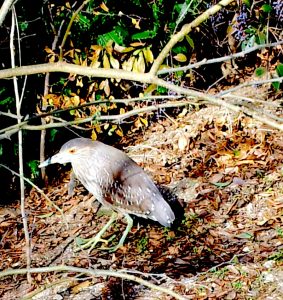
In the new year, consider how long Joe’s Creek has run its course as part of the natural watershed. When bison roamed the area, buffalo wallows along the creek served as natural flood water retention ponds. Today, birds, like this juvenile green heron seen shortly after new year, and wildlife of all sorts still find Joe’s Creek a home, or a stopover on their migrations. Native trees and shrubs anchor the banks. (We have plans for some of the invasive plants!) Yet the creek, which also serves as our storm water channel, needs our help to remain a lively watercourse.
NPNA neighbors and other volunteers are champions at clearing and cleaning the banks and the stream bed periodically. Keeping the water itself clean, however, depends upon all of us keeping contaminants out – pesticides, oils and detergents, pool chemicals, even leaves and yard waste – on a daily basis. See Dallas Storm water Department’s www.wheredoesitgo.com for a more detailed picture.
Let’s resolve to enjoy the creek this year, and also work to keep it natural and clean for the years to come.
Vince Punaro & Rebecca Bergstresser
It’s Summer at the Creek!
August 2013.
That means hovering dragonflies (our most effective mosquito killers), low water levels, pools full of tiny fish, lots of green slime, and continuing masses of fertilizer-induced bubbles. As yard watering becomes more necessary, it’s a good time to check your system to make sure your water is going on your grass and not down the gutter into the creek – where its chemicals may contribute to growth in the creek bed. (For an example of such growth, check the south side of the Alta Vista bridge).
Speaking of plant growth in the creek area, your committee chairs, along with Kiki Paschall, VP Events and Jan Mateja, Bed Maintenance Leader, joined Dallas City Arborist Karen Woodard on a walk to evaluate the tree and shrub situation along the creek. Her message: the trees and bushes growing along the creek are essential to maintaining the banks and protecting the creek channel! Karen noted that some species, such as the black willow, that provides both erosion control (with its tenacious root system) and wildlife habitat (woodpeckers are often seen in high branches of these trees) are becoming increasingly rare in the city. These trees are difficult to grow in the nursery trade, so natural preservation is important.
Karen also pointed out that the creek and its surrounding green space are city property, and the city will work with us to maintain the integrity of the creek and its surroundings. If we perceive a problem with water flow or vegetation in the creek, a call to 311 will bring a city representative promptly to the scene to assess the situation. Your creek committee chairs can also assist you with these issues.
So, enjoy our unique neighborhood resource as you keep cool this summer – and thank the dragonflies!
Vince Punaro & Rebecca Bergstresser
What’s That In the Creek??!!!?
July 2013.
One of the pleasures of living near Joe’s Creek is looking for the familiar things that show up each year – turtles, tadpoles, dragonflies, odd rocks, flowering bushes, and more. Usually we have a clue what we are looking at, or can make an informed guess.
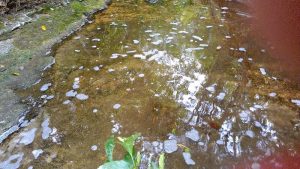
But this year, as the weather warmed up and the water level dropped, there has been something new: bubbles. Lots of them. So many they have clumped into floating masses several yards long, stranding themselves in the creek in tacky, grimy patches of scum. Uh oh!
Fearing the worst, your creekwatchers called Dallas Water Utilities. It was gratifying that a water quality specialist showed up within a few hours and collected samples to test for hazardous substances.
The findings? Traces of phosphates and chlorine. What this means: sprinkler systems are washing fertilizer off area lawns, down the gutters and into the creek – something that can be documented on early morning walks almost every Sunday and Thursday. It’s a waste of both water and fertilizer. Money down the drain, you might say.
The good news is that the levels found were not high enough to endanger wildlife or pose an immediate public health hazard to humans. The not so good news? The resulting plant growth in the creek could obstruct water flow during heavy rains, creating a flood hazard. The area south of the Alta Vista Bridge was cited as an example.
What to do?
- Check your sprinkler systems to make sure they are watering your grass, not your street.
- Make sure your fertilizers are applied to grass only – not paved areas.
- Use organic and natural products such as corn meal and dried molasses. These are less likely to wash away, and they improve your soil as well as feeding your lawn. And hopefully, they won’t bubble up the creek!
Vince Punaro & Rebecca Bergstresser
A Few Words re Coyotes, Cats, and Birds
February 2013.
Those who live close to Joe’s Creek and its green belt and park enjoy a special window on the wild – a rare natural haven for wildlife in the midst of a major city. Its trees provide shelter and food for birds during winter and fall migrations, and nesting areas for birds that stay through the summer. Raccoons and possums populate the area, and various turtles (mostly releases from home aquariums) bask in the summer waters, while minnows dart in the shallows. Ducks often nest along the creek, possibly returning to the very place where they hatched.
As grassland and open areas have disappeared, coyotes and bobcats have found the creek a perfect path into our neighborhood. Here, as in urban areas all around the U.S., they are finding food and cover, and conditions to their liking. At the same time, roaming house cats and feral cats are drawn to the creek. Wildlife and domestic pets thus meet and compete in our area, with distressing results: cats and small dogs killed or injured by coyotes; migratory and nesting birds and their fledglings hunted and destroyed by domestic and feral cats. Without taking sides, we believe that we can best protect our pets and make our area safer for wildlife by adhering to the following guidelines:
- Keep small pets (cats and dogs) indoors, or in enclosed outdoor areas. Domestic cats are vulnerable to injury and disease outdoors, since they are more likely to roam and encounter non-vaccinated cats or other animals. Veterinarians tell us that “The life span of cats outdoors averages only about 2 years, dramatically less than the 15+ years that we can expect with a healthy indoor cat. Don’t simply feed ferals, TNR (trap neuter return) programs such as the one successfully established by Kittico in Dallas can operate to control and ultimately diminish the population in as humane a manner as possible.”
- Don’t encourage wild animals by feeding them, either deliberately or accidentally. In fact, do discourage bold coyotes – any that you see in daylight or any that come close to or onto your property – by loud noise, by (carefully) throwing small objects, and otherwise making it clear that they are to keep clear. Don’t just take their pictures, wildlife consultants tell us, “We know what they look like!” Do tell your neighbors – a timely warning may save a pet. For more information on “coyote hazing” techniques see the U.S. Humane Society.
- If you feed your pet(s) outdoors, do not leave uneaten food out overnight.
Vince Punaro & Rebecca Bergstresser
December at The Creek
December 2012.
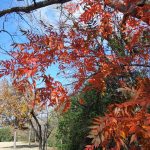
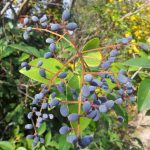
Often in December it seems like it’s still summer, then its Christmas. This year its FALL on Joe’s Creek, subtle in some places, in technicolor in others. In addition to the familiar red oaks and yellow elms, and some new green cedars getting established, visitors to the creek this week can still see the aptly named flame sumac, and various shrubs and trees with purple as well as bright red berries. It should be a good crop for the avian visitors too. And in spite of the drought, some water is flowing in the upper reaches of the creek.
Walk your dog, meet your friends, or just walk Joe’s Creek this week. Below are some of the vistas you will see:

Vince Punaro & Rebecca Bergstresser
Contaminants in Joe’s Creek
November 2012.
While we may have varying opinions about the elections, we can all agree on some positive action for the good of Joe’s Creek: Let’s endorse continued vigilance of what is happening in the creek, to keep it clean, safe, and free of pollutants for everyone in the neighborhood.
Neighbors recently reported observing contaminants in the water of Joe’s Creek, including a milky white appearance that has occurred overnight on a number of occasions, perhaps indicative of a pattern of polluting, and in another case, an oily sheen on the water, suggestive of motor oil. Debris consisting of loose soil with broken glass and bits of pvc on the banks of the creek was also noted and reported to the city. The City of Dallas Stormwater Department assured us that they want to know about these instances, and such actions can be reported by calling 3-1-1.
The City of Dallas Stormwater page, www.wheredoesitgo.com, contains more detailed information on pollutants (did you know one quart of motor oil can contaminate 250,000 gallons of water) and also links to brochures that specify fines (of up to $2000 per occurrence) for willful discharge of pollutants into storm drains, including leaves and rubbish as well as chemicals.
We on the Creek Committee would also like to be notified, and will assist in following up with the city if needed. We can be contacted at creek@npna.org
Vince Punaro & Rebecca Bergstresser
October 2012 NPNA Monthly Newsletter
Click on this link to open up the NPNA October monthly Newsletter: